
Community Storytelling Initiatives and Their Social Impact on Families
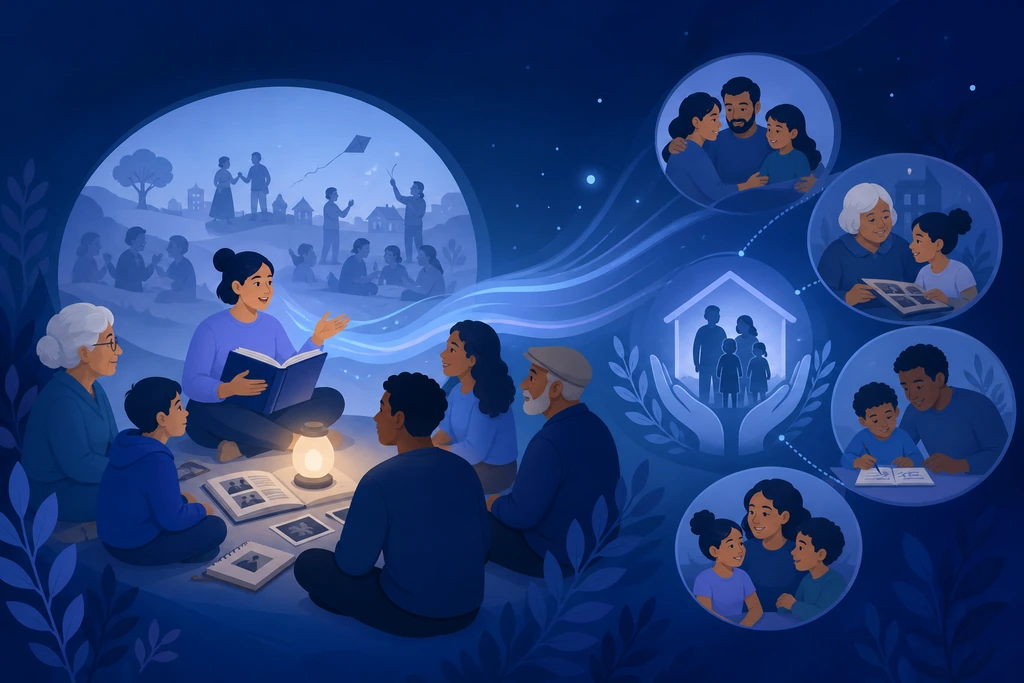
Discover how community storytelling initiatives and their social impact on families help bridge generational divides and strengthen households. This page explores structured oral history projects, local memoir groups, and digital archives that capture lived experiences. Learn how shared family narratives build resilience, examine measurable social outcomes, and see how public spaces support these vital cultural programmes.
Evaluating Family and Community Storytelling Programmes
| Initiative Aspect | Positive Social Impact | Identified Limitations |
|---|---|---|
| Oral History Projects | Preserves local heritage and strengthens family bonds | High risk of uneven funding and resource gaps |
| Digital Archives | Creates accessible records for future generations | Marginalises populations without digital literacy or access |
| Library Memoir Groups | Fosters cross-generational dialogue and emotional support | Limited reach due to reliance on physical spaces |
| Facilitated Interviews | Ensures narrator control over final recorded material | Requires trained staff and significant time commitment |
Developing Community Storytelling Initiatives
-
Establish the Project Scope
Define the geographical area or specific group for your oral history project. Secure basic recording equipment and ensure trained facilitators lead the initiative.
-
Obtain Informed Consent
Ensure every participant signs a written consent form before recording. This guarantees that narrators retain full control over the final edit and distribution.
-
Record Lived Experiences
Conduct structured oral history interviews using quality microphones. Focus on capturing authentic daily life, family narratives, and local memories.
-
Shape and Archive Narratives
Organize the recorded interviews into coherent digital archives or library memoir collections. Preserve these materials carefully for future generations and researchers.
-
Measure Social Impact
Evaluate how these shared family narratives build resilience within the community. Assess the measurable benefits of storytelling on local residents and family bonds.
-
Share with the Public
Publish the finished material through accessible public outlets like community exhibits or online archives. Ensure diverse voices are included despite uneven funding challenges.
What Counts as Community Storytelling
Community storytelling initiatives are organised programmes that help residents record, shape and share lived experience through oral history interviews, library memoir groups, and digital archives built around a single street or trade. Scale varies sharply. A parish project may hold forty recordings; citywide schemes backed by public libraries have logged tens of thousands. What unites them is method — a trained facilitator, written consent, a decent microphone and a public outlet for the finished material. Unlike commercial media, the narrator keeps control of the edit. Evaluators usually describe three outputs: an archive, a public event and a shift in how participants describe their own family. The last is hardest to count and most often claimed. Programmes that publish without consent frameworks, or that treat residents as content sources rather than authors, tend to collapse after the first grant cycle. Structure, not sentiment, keeps them running across diverse demographic groups.
How Family Narratives Build Resilience
Research on family narrative coherence supplies the field's most cited evidence. In a landmark study, psychologists Marshall Duke and Robyn Fivush built a twenty-item scale asking children whether they knew how their parents met, where grandparents grew up, or a family illness or triumph. Higher scores correlated with stronger self-esteem, an internal locus of control and better family functioning. A follow-up after major crises found children with richer family knowledge showed more resilience. The mechanism is not mere nostalgia. Knowing that relatives survived job losses, migration or bereavement gives a child a tangible template: trouble is survivable and shared across generations. Programmes that record grandparents answering those exact questions turn academic research into daily practice. The gain depends on repetition, not archiving. A recording nobody plays changes nothing; a fifteen-minute clip replayed at dinner becomes household vocabulary. Facilitators who prompt for specifics get usable material.
Storytelling Initiatives, Measured Impact
Funders increasingly ask for outcomes, so organisers need numbers that survive strict external scrutiny. Practical metrics include recruitment against target, completion rate in volunteer oral history projects, recordings deposited in a permanent archive, and a three-month follow-up on whether participants shared their material with anyone. Attendance figures alone flatter any free event. Standard wellbeing instruments allow a cost-per-point comparison with other public interventions. Qualitative coding of participant interviews adds what numbers miss: changes in contact with relatives, willingness to speak in public, and a stronger sense of local belonging. Assessment of community storytelling initiatives and their social impact on household routines tends to be weakest exactly where the claims are loudest, which is why baseline interviews before week one matter. Budget a fixed percentage of project costs for evaluation and publish the awkward findings; commissioners trust a programme that reports its dropout rate. As local narratives gain traction, the-evolution-of-storytelling-from-traditional reveals how shifting from print to digital media expands their reach and social impact.
Community Storytelling Impact Insights
Definition of community storytelling initiatives
How family narratives build resilience
Measured impact of local projects
Exclusion factors in public archives
Role of libraries and museums
Who Is Left Out
Participation rarely mirrors the wider neighbourhood accurately. Volunteer-led story projects consistently over-recruit retired, home-owning residents with spare weekday hours and under-recruit shift workers, young renters and people with heavy caring responsibilities. Digital-first delivery widens the gap: roughly one in ten adults still lacks basic digital skills, and recording apps assume a smartphone with sufficient storage and data. Language is a second filter — projects that advertise only in the majority language quietly exclude bilingual households whose stories are often the most layered. Disability access means captioning, transcripts, quiet rooms and venues on a bus route, not merely a ramp. Free sessions still cost participants travel time and childcare. A useful test is to list who attended the last three sessions and compare it with census data for the postcode. Where the mismatch is large, the fix is structural rather than promotional:
- crèches and evening slots for shift workers;
- paid interpreters and translated flyers;
- payment for community members' time, not thank-you certificates.
Libraries, Museums, Uneven Funding
Longevity depends on institutional hosts rather than individual enthusiasm. Public libraries remain the most reliable base: the national networks run thousands of branches, offer free meeting space, and hold archival expertise that small groups cannot buy. Museums and local record offices add conservation standards and cataloguing systems that keep recordings playable in twenty years. Schools bring a captive audience of children and grandparents, though term-time timetables constrain scheduling. Health referral routes can fund participation for people with loneliness or mild depression, provided the programme can evidence outcomes. Analysis of community storytelling initiatives and their social impact on family contact often stops at the anecdote, which is why partnership agreements should specify who owns consent forms and who maintains the archive after the grant ends. Most schemes run on short cycles; assume core costs are unfunded and design a modest reserves line.
Record One Conversation This Week
Families rarely need permission to begin; they need a reliable method. Start with a single twenty-minute conversation, recorded on a phone in a quiet room with the window shut, and ask one concrete question — how did you get to this town — rather than a broad one about the past. Say out loud who will hear the file, send everyone a copy, and store two backups in separate places with names and date in the filename. Transcripts matter more than polish: a free auto-transcription tool plus twenty minutes of correction yields a searchable document that grandchildren will actually read. Deposit a copy with the local record office or library archive, where it survives house moves and dead hard drives. Debates about community storytelling initiatives and their social impact on family life usually stay abstract; the practical advice is simpler — set a date this week, arrive with three focused questions, and record before another relative's memory fades away completely.