
The Role of Illustrated Storytelling in Supporting Childhood Resilience
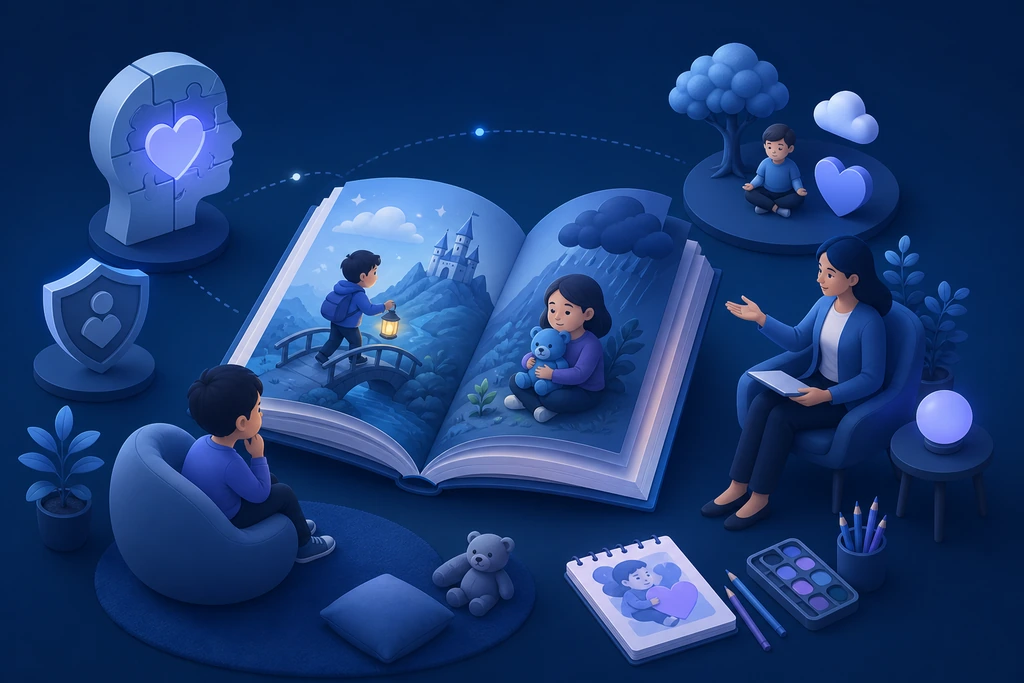
A four-year-old who cannot yet name frustration can still point to a fox with flattened ears and feel understood. That immediate act of recognition highlights the role of illustrated storytelling in supporting childhood emotional development. By allowing young readers to match visual shapes and colours to internal states they cannot yet articulate, picture books offer a low-threshold entry point for processing complex feelings safely and naturally.
Why Pictures Carry Emotional Weight
A four-year-old who cannot yet name frustration can still point at a fox with flattened ears and say, 'He is like me.' That act of recognition is where emotional literacy starts, and it accounts for much of the role of illustrated storytelling in supporting childhood development. Words alone ask a child to translate feeling into vocabulary they may not possess; images let them match a shape, a posture or a colour to an internal state they recognise but cannot articulate. Researchers in visual literacy call this a low-threshold entry point — the picture does the semantic work, and language follows. A spread showing a character hunched under a blanket communicates more reliably than a sentence explaining loneliness. The format also slows a story to a child's processing speed, which matters when the subject is fear, loss or shame, and it creates a shared reference point that parent and child can return to long after the book is closed.
Reading the Spread, Not the Text
The functional unit of a picture book is not the sentence but the spread, where text and image either reinforce or contradict each other. Counterpoint — words saying one thing, pictures another — gives a child practice in reading subtext, an early form of empathy. When a character's shoulders drop and the palette shifts to grey while the text insists everything is fine, the reader learns that feelings can be inferred rather than announced. This matters for resilience because it models the gap between what people say and what they carry. A second mechanism is distancing: naming the feeling on a fictional bear is safer than naming it on yourself. The child projects, examines and withdraws without exposure. Narrative supplies sequence, and sequence supplies the reassurance that states change — the frightened page is always followed by another page. That structural promise, that a difficult moment is a passage rather than a permanent condition, is the quiet engine of the form.
Three Mechanisms Behind the Effect
Strip away the marketing and three distinct processes do the work.
- Identification: a character becomes a proxy the child can inhabit without risk — the fear belongs to the rabbit, not to the reader.
- Lexical scaffolding: the story supplies words such as worried, left out or brave that a child can borrow before owning them.
- Rehearsal: repeated readings let a child predict, then tolerate, the tense spread, and familiarity turns threat into something manageable.
Individually each mechanism is modest. Meta-analyses of bibliotherapy in school settings report small-to-moderate effects, strongest for anxiety in children aged four to eight and weakest when books are distributed without discussion. Combination is what counts: identification without vocabulary leaves a child inarticulate, while vocabulary without repetition fades within weeks. Timing changes the function as well. A story introduced before a stressful event — a first hospital appointment, a sibling's arrival — works as rehearsal; the same title introduced afterwards works as repair. Both are legitimate; they are not interchangeable. Beyond the page, broader community-storytelling-initiatives-and-their-social help extend these resilience-building practices into wider neighborhood networks.
Visual vs Textual Approach in Childhood Emotional Resilience
| Illustrated Storytelling | Text-Only Storytelling |
|---|---|
| Provides low-threshold entry for pre-verbal children | Requires developed vocabulary to understand internal states |
| Allows matching shapes and colours to emotions | Asks children to translate feelings into words directly |
| Uses visual metaphors like posture and white space | Relies strictly on semantic definitions and narrative text |
| Supports emotional literacy through external character recognition | Limits accessibility for children struggling with verbal expression |
One Boy, One Bear, Eight Weeks
Consider a six-year-old referred to a small urban library's reading group after four months of night waking following his mother's surgery. He refused to discuss the hospital. Over eight weekly sessions the librarian read a picture book about a bear cub whose parent disappears for a season and returns; the text never mentions illness. The boy asked for the same title six times. By week five he had begun annotating the illustrations aloud — 'the bear is scared here, but he doesn't know the way back' — a phrase his mother had not heard. Parent-reported night waking fell from five nights a week to two. Nobody called this therapy; no clinical records were kept. The plausible mechanism was not the story's content but its repetition: a predictable sequence he could control, with a separation that always resolved. The caution is instructive — a second child in the same group showed no change, and the librarian referred the family onward.
Not Every Sad Page Helps
The format has a ceiling, and pretending otherwise misleads parents. A picture book cannot diagnose or treat a child showing persistent sleep loss, regression or withdrawal; such signals warrant a paediatric or psychological referral, not another bedtime story. Within its proper scope the form still fails predictably. Stories that resolve distress too quickly teach children that their own timeline is wrong. Didactic texts that state the lesson in the final line flatten the ambiguity the illustrations worked to build. Material chosen by adults for adult reasons misfires: a book about bereavement handed to a child after a house move does not match the experience, and the mismatch is visible to the reader. Cultural framing is a further variable, since family norms around expressing fear or grief vary widely and what reads as honest in one household can read as exposing in another. None of this diminishes the role of illustrated storytelling in supporting childhood resilience; it locates that role precisely.
Colour, Pause, and White Space
Craft decisions carry as much emotional information as the plot. A palette that desaturates as tension rises, then warms by two or three degrees on the resolving spread, gives a pre-verbal reader a signal they can act on without explanation. White space functions as breathing room: a page with one small figure low in the frame tells a child the feeling is big without using the word. Pacing matters more than rhyme. Editors note that the strongest resilience-focused manuscripts leave a beat of silence after the difficult moment instead of rushing to comfort, because the pause is where a child inserts their own experience. Typography is not neutral either; broken, jagged line placement signals alarm, while a steady baseline implies the world holds. None of this requires high production values. Cheap paper and two ink colours can carry the same architecture when the sequence of images is thought through.
Adults Set the Emotional Temperature
Outcomes depend less on the book than on the adult holding it. Dialogic reading — pausing to ask 'what do you think he is feeling?' rather than reading straight through — turns a passive story into a rehearsal of emotional vocabulary. Research on shared reading consistently finds that the number of affective words a child hears in conversation, not the number printed on the page, predicts later regulation. Tone matters too: an adult who reads the frightening spread quickly and cheerfully signals that the fear is not discussable, while a slower reading and an honest pause signal the opposite. This is where the role of illustrated storytelling in supporting childhood resilience is either realised or wasted. Caregivers need no training, but they do need permission to sit with discomfort for thirty seconds instead of resolving it. The book supplies the shared object; the adult supplies the safety that makes examining it possible. Neither works alone.